

Before you build another course, pause here.
Most learning projects begin with a familiar request:
“We need training.”
Sometimes that request is exactly right. But often, it is only the first clue that something else is happening underneath the surface.
A team may be struggling with inconsistent onboarding. A process may be unclear. Managers may be repeating the same explanations again and again. Learners may be completing courses but still not applying the information correctly. Stakeholders may be asking for a new module, a refreshed course, or an LMS update without first confirming the real performance need.
That is where Learning Architecture matters.
Learning Architecture helps organizations step back before building and ask the questions that determine whether the final learning experience will actually work.
What problem are we trying to solve?
Who needs to change what they know, do, or decide?
What does success look like after launch?
What content is essential, and what is simply noise?
Where will the learning live?
How will learners practice?
How will we know whether the experience made a difference?
When those questions are skipped, training can still get built. But it is much more likely to create rework, confusion, low adoption, poor measurement, and stakeholder frustration.
Learning Architecture is the work that helps teams build the right thing before they spend time, budget, and energy building the thing right.
What is Learning Architecture?
Learning Architecture is the strategic structure behind an effective learning experience.
It connects the learning need, audience, content, design approach, technology, implementation plan, and measurement strategy into one coherent system. Instead of treating training as a single course or one-time deliverable, Learning Architecture views learning as an experience that must be planned, designed, built, launched, supported, and improved over time.
At Emerge ID, we think of Learning Architecture as the bridge between a business or organizational need and a learning experience people can actually use.
That means it includes more than instructional design alone. It may involve:
- Clarifying the problem before recommending a solution
- Aligning stakeholders around goals and expectations
- Organizing content into a learner-friendly structure
- Designing practice and application, not just information delivery
- Choosing the right LMS or learning platform approach
- Planning implementation so learners know what to do next
- Defining meaningful metrics before launch
- Creating a sustainment plan so learning improves over time
In plain language, Learning Architecture keeps learning projects from becoming a pile of disconnected pieces.
It creates the blueprint.
Why training requests are not always training problems
One of the most expensive mistakes organizations make is assuming that every performance issue requires a course.
A training request might sound like this:
“Our employees are not following the process. We need a refresher course.”
But after a closer look, the real issue might be that the process is unclear, the job aid is outdated, managers explain the process differently, the LMS is hard to navigate, or employees do not have enough practice making decisions in realistic situations.
In that case, building a course without clarifying the real need may only add another layer of frustration.
This does not mean training is unnecessary. It means training should be designed around the right problem.
Learning Architecture helps teams separate symptoms from causes. It gives stakeholders a clear way to evaluate what learners need, what the organization expects, and what type of solution will create the most useful result.
Sometimes the answer is a full course.
Sometimes it is a short pilot module.
Sometimes it is a redesigned onboarding path.
Sometimes it is an LMS cleanup.
Sometimes it is a better measurement strategy.
Sometimes it is a combination of several targeted building blocks.
The value is not in building more learning. The value is in building learning that solves the right problem.
The cost of skipping Learning Architecture
When organizations move straight from “we need training” to “let’s build a course,” the hidden costs usually appear later.
Stakeholders disagree after development has already started. Subject matter experts add more and more content because the scope was never clearly defined. Learners complete the course but still do not feel confident. Leaders ask whether the training worked, but the only available metric is completion. The LMS technically hosts the course, but learners struggle to find it, access it, or understand what they are supposed to do next.
None of these problems happen because people do not care.
They happen because the project moved into production before the learning architecture was clear.
Skipping this step often leads to:
- Rework and revision loops
- Bloated content
- Confusing learner experiences
- Weak adoption
- Poor transfer to real work
- Frustrated SMEs
- Unclear reporting
- Training that launches but does not change behavior
Learning Architecture reduces those problems by creating alignment before development begins.
It helps teams make better decisions earlier, when those decisions are still easier and less expensive to change.
What Learning Architecture looks like in practice
A strong Learning Architecture process does not need to be overwhelming. The goal is not to slow the project down. The goal is to prevent the project from speeding in the wrong direction.
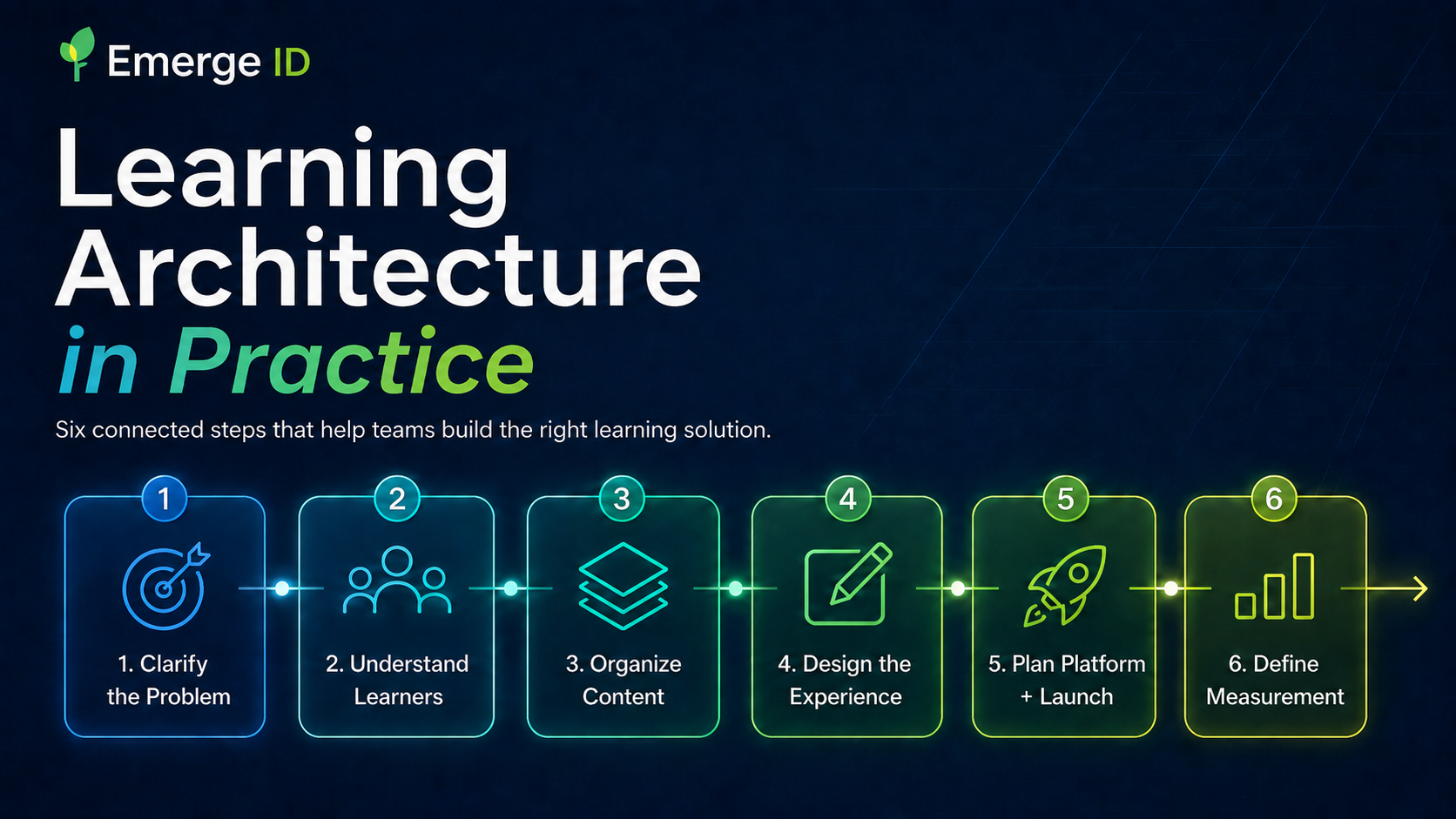
A practical Learning Architecture process usually includes six connected steps.
1. Clarify the learning problem
Before designing anything, define the problem clearly.
What is happening now?
What should be happening instead?
Who is affected?
What is the cost of leaving the issue unresolved?
What does the organization need learners to know, do, decide, or improve?
This step creates focus. It also helps prevent the common pattern of building training around vague goals like “increase awareness” or “improve understanding” without defining what successful performance looks like.
2. Understand the learners and context
Learning does not happen in a vacuum.
A strong design considers who the learners are, what they already know, what barriers they face, what motivates them, what tools they use, and how the learning fits into their real work.
This is where accessibility, cognitive load, time constraints, role expectations, and learner confidence matter. If the experience feels too confusing, too long, too generic, or too disconnected from the learner’s reality, adoption will suffer.
Learning Architecture helps design for the actual learner, not the idealized learner.
3. Organize the content
Many training projects begin with too much content.
Learning Architecture helps identify what is essential, what is supporting information, what belongs in the course, and what may be better suited as a job aid, manager guide, checklist, resource library, or follow-up communication.
This is one of the most important steps for reducing cognitive load.
Learners do not need everything a subject matter expert knows. They need the right information, at the right time, organized in a way that helps them act.
4. Design the learning experience
Once the problem, audience, and content are clear, the learning experience can be designed intentionally.
This includes the course structure, interaction strategy, practice opportunities, feedback loops, assessment approach, multimedia plan, and learner journey.
For simple awareness or onboarding, the design may focus on clarity, confidence, and recall. For roles that require judgment, the experience may need scenarios and decision-making practice. For high-stakes work, learners may need deeper practice, performance criteria, and validation before the solution scales.
This is where Learning Architecture protects the project from becoming “content on slides.”
5. Plan the platform and implementation
Even a well-designed course can fail if the launch experience is confusing.
Learning Architecture considers where the learning will live, how learners will access it, what the LMS needs to track, how managers or facilitators will support it, and what communication is needed before and after launch.
This matters because learner adoption is shaped by friction.
If people cannot find the course, do not understand why it matters, or do not know what to do after completion, the learning experience loses momentum.
6. Define measurement before launch
Completion is not the same as effectiveness.
A strong Learning Architecture process defines what should be measured before the course launches. That may include participation, completion, assessment performance, learner confidence, manager feedback, behavior change, operational indicators, or other meaningful signals.
The key is to decide what evidence will help the organization answer better questions:
Did learners understand the content?
Can they apply it?
Are they more confident?
Are managers seeing improvement?
Where are learners struggling?
What should we improve next?
Measurement should not be an afterthought. It should be built into the architecture from the beginning.
When should an organization use Learning Architecture?
Learning Architecture is especially useful when a project has real stakes, multiple stakeholders, unclear scope, or a history of rework.
It is a smart starting point when:
- A team keeps asking for training but the root problem is unclear
- Onboarding is inconsistent across locations, departments, or managers
- Existing courses are outdated, too long, or underused
- An LMS has become difficult to manage or navigate
- Leaders want better reporting than completion data
- A learning project has stalled because stakeholders are not aligned
- SMEs have valuable knowledge, but it is scattered or trapped in people’s heads
- The organization needs a pilot before investing in a larger build
- Learners need practice, not just information
In these situations, Learning Architecture gives the team a clearer path forward.
It turns uncertainty into a plan.
A better way to begin: start with clarity
The best learning projects do not begin with development.
They begin with clarity.
That clarity does not have to take months. It can start with a focused needs analysis, a Learning Architecture Starter Kit, a pilot module, or a targeted strategy conversation.
The important thing is to pause long enough to make sure the solution matches the actual need.
At Emerge ID, our Learning Architecture approach helps organizations move from scattered requests to structured solutions. We help teams clarify the problem, design useful learning experiences, choose the right technology path, build with accessibility and measurement in mind, and improve the experience after launch.
Because the goal is not just to launch training.
The goal is to create learning that people understand, use, and trust.
Ready to build the right thing before you build the course?
Before you invest in another course, module, or LMS update, take time to clarify the learning problem first.


14 Comments